Every dog needs the core vaccines: distemper, adenovirus (hepatitis) and parvovirus, plus rabies. Puppies usually start at 6 to 8 weeks, get a shot every 2 to 4 weeks until they are at least 16 weeks old, then a booster between 6 and 12 months. After that, core vaccines are usually given every 3 years. Rabies rules are set by each country, and sometimes by each state or city. Choose your country below for the local rules and a printable checklist.
Dog vaccination chart
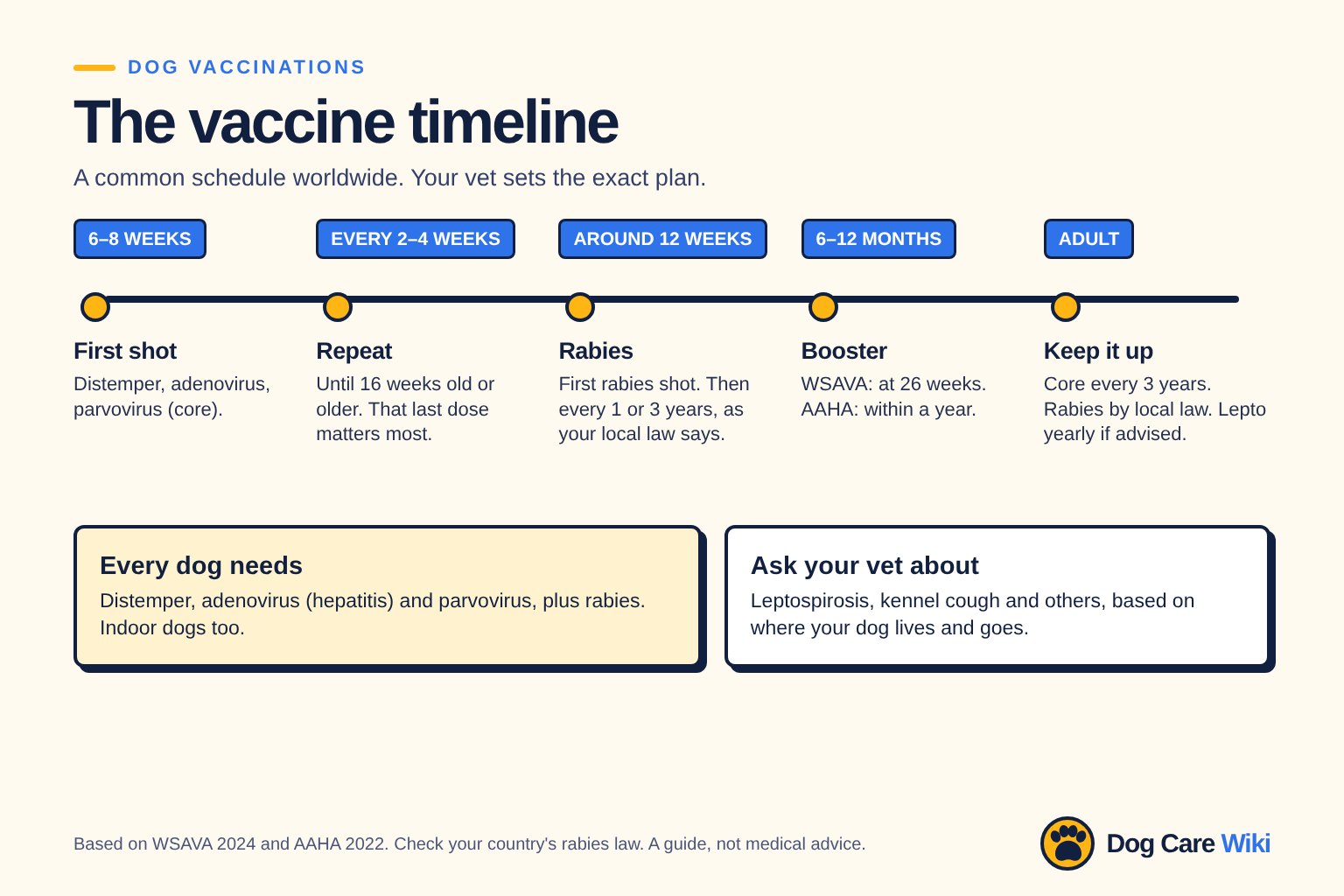
- Puppy: start at 6–8 weeks, repeat every 2–4 weeks to 16 weeks+
- Rabies: first shot around 12 weeks, then as local law says
- Booster: at 26 weeks (WSAVA) or within a year (AAHA)
- Adult: core every 3 years
The quick guide
Distemper (core)
A serious virus that can affect the lungs, gut and brain. Part of the puppy series and adult boosters for every dog.
Adenovirus, or hepatitis (core)
Protects against infectious canine hepatitis. Usually given in the same shot as distemper and parvovirus.
Parvovirus (core)
Parvo is often deadly for unvaccinated puppies. See our parvo guide for the signs.
Rabies (core where rabies is found, or where the law requires it)
The WHO says that once signs appear, rabies is virtually 100% fatal. WSAVA calls rabies vaccination essential wherever rabies is common. Many countries require it by law.
Leptospirosis (ask your vet)
A bacterial disease that can also make people sick. WSAVA says it should be treated as core where it is common and suitable vaccines exist. It needs a yearly booster. See our leptospirosis guide for the signs.
Kennel cough (ask your vet)
Covers Bordetella and parainfluenza. Often suggested for dogs who board, go to groomers or meet many other dogs.
Coronavirus and Giardia (not recommended)
WSAVA lists these as "not recommended" because there isn't enough evidence they help. Some combination vaccines sold in some countries still include coronavirus.
What to do this week
- Choose your country below and read its rules, especially for rabies.
- Download your country's checklist, or our free printable dog vaccination record (PDF), and fill in the dates from your dog's vaccine card.
- If you can't find a record, ask your vet. They may restart some vaccines or check antibody levels.
- Book any vaccine that is due.
- Write the next due dates somewhere you'll see them, like the free care planner in our dog health tracker.
Choose your country
Each guide covers the local rabies law, the vaccines and combination shots sold there, free vaccination programs, and a printable checklist. Guides for other countries are written in the language people there search in.
United States
AAHA puppy vaccination schedule, plus how rabies laws differ from state to state.
Philippines
Puppy shots schedule, the 5-in-1, and the yearly anti-rabies shot required by RA 9482.
대한민국
South Korea강아지 예방접종 시기와 비용, 매년 광견병 접종, 동물등록 의무.
日本
Japan子犬のワクチンスケジュール、混合ワクチンの種類、狂犬病予防注射と登録の義務。
Brasil
BrazilV8 ou V10, antirrábica anual e a carteirinha para imprimir.
México
MexicoCalendario, antirrábica gratis cada año (NOM-011) y cartilla para imprimir.
Chile
Antirrábica obligatoria (Decreto 1), Registro Nacional de Mascotas y carnet para imprimir.
Colombia
Puppy y pentavalente, antirrábica gratis cada año y carnet para imprimir.
Estados Unidos
United States (Spanish)Calendario de la AAHA, leyes de rabia por estado y cartilla para imprimir.
Puppy vaccination schedule
WSAVA, the World Small Animal Veterinary Association, recommends starting core vaccines at 6 to 8 weeks of age, then giving one every 2 to 4 weeks until the puppy is 16 weeks old or older. AAHA, the American Animal Hospital Association, gives a similar schedule.
Puppies need several shots because antibodies from their mother can block a vaccine from working. Those antibodies fade at different times in different puppies, so the series keeps going until they are surely gone. WSAVA says the most important dose is the one given at 16 weeks or older.
The two groups differ on the next booster. WSAVA advises one at or soon after 26 weeks. AAHA advises one within a year of the puppy series.
How often adult dogs need vaccines
After the first adult booster, WSAVA and AAHA both say core vaccines are needed no more often than every 3 years. AAHA says annual core boosters are not necessary. WSAVA adds that vaccines should not be given needlessly.
Some vaccines are still yearly. Leptospirosis and kennel cough protection lasts about a year. Rabies follows the law where you live, and WSAVA says that where the law differs from the vaccine label, the law must be followed. Practice also varies: in some countries, yearly combination vaccines are still common. Your country's guide explains the local approach.
Adopted dogs and unknown vaccine history
If you adopt an adult dog with no records, your vet will likely restart the core vaccines. WSAVA says a single dose of a modified-live core vaccine is usually enough for an adult dog. AAHA suggests two doses, 2 to 4 weeks apart. Leptospirosis always needs two starting doses.
Some vets offer a blood test that checks antibody levels (a titer test) instead of revaccinating. WSAVA supports titer testing. AAHA says titers are rarely recommended for healthy dogs. Ask your vet what they suggest.
Side effects
Mild reactions are common and pass quickly: a sore or swollen spot where the shot went in, sleepiness, low appetite or a mild fever for a day or so.
Serious reactions are rare. In one large study from Japan cited by WSAVA, about 63 in every 10,000 dogs had any reaction, and most started within 12 hours. WSAVA notes that small dogs given several vaccines at one visit are at higher risk. If your dog had a reaction before, tell your vet before the next shot.
Dog vaccination record template (free printable)
A clear record helps your vet, and you'll need it for boarding, grooming, travel and local rabies rules. WSAVA recommends recording:
- The date of each vaccine.
- The vaccine name, manufacturer, lot number and expiry date.
- Who gave it, and where on the body.
- When the next dose is due.
Print it: Free printable dog vaccination record (PDF). Page 1 has the common schedule and a vaccine record table with space for all of these. Page 2 logs parasite prevention and medicines, so your dog's whole health record is in one place. Each country guide above also has its own version with local rules.
To keep the dates on your phone too, use the free care planner in our dog health tracker, and join early access for reminders.
How to get your dog's vaccination records
- Call the clinic that gave the shots. Vet clinics keep vaccine records and can usually send a copy.
- Ask for the rabies certificate. It is signed by the vet, and it is usually the record that rabies laws and pet travel rules ask to see.
- Check where your dog came from. A breeder, shelter or rescue may have records of shots given before you got your dog.
- Still nothing? Your vet may restart the core vaccines or offer a titer test. See the section on unknown vaccine history above.
Once you have the dates, copy them onto the printable record so everything is in one place.
Moving or traveling with your dog
Every country sets its own import rules, and many need a rabies vaccine, a microchip and sometimes a blood test months before travel. Check the rules of the country you're going to with your vet well ahead of time.
Common questions
What vaccines does my dog need?
Every dog needs the core vaccines: distemper, adenovirus (hepatitis) and parvovirus, plus rabies where rabies is found or the law requires it. Your vet may also suggest leptospirosis or kennel cough vaccines based on where your dog lives and goes.
Do indoor dogs need vaccines?
Yes. Core vaccines are recommended for all dogs, whatever their lifestyle, and rabies laws usually apply to every dog.
Does my dog need vaccines every year?
Not all of them. After the first adult booster, WSAVA and AAHA say core vaccines are needed only every 3 years. Rabies follows your local law, which may be every year or every 3 years. Leptospirosis and kennel cough are yearly if your vet recommends them.
Can I walk my puppy before all the shots are done?
Early, careful socialization matters. The American Veterinary Society of Animal Behavior supports puppy classes from 7 to 8 weeks, with at least one set of vaccines a week before and no dog parks. Ask your vet which places are safe in your area.
What if my puppy missed a vaccine?
Call your vet. They may simply give the next dose or adjust the schedule. The dose at 16 weeks or older is the most important one.
Where can I get a printable dog vaccination record?
Download our free printable dog vaccination record (PDF) from this page. It has the common schedule and a table for the date, vaccine, brand and lot number, vet, and next due date. Each country guide also has its own version.
How do I get my dog's vaccination records?
Ask the vet clinic that gave the shots for a copy, including the rabies certificate. If your dog came from a breeder, shelter or rescue, ask them too. If no records can be found, your vet may restart the core vaccines or suggest a titer test.
Why are vaccine schedules different in different countries?
The diseases that are common, the vaccines that are licensed and the laws, especially for rabies, differ from country to country. That's why each country has its own guide here.
Veterinary sources
- WSAVA: 2024 Guidelines for the Vaccination of Dogs and Cats (full paper) ↗
- WSAVA: 2024 vaccination guidelines summary ↗
- AAHA: 2022 Canine Vaccination Guidelines toolkit ↗
- AAHA 2022 guidelines summary (OAVT presentation) ↗
- World Health Organization: Rabies fact sheet ↗
- AVSAB: Position statement on puppy socialization ↗
- VCA: Allergic reactions in pets ↗
Medical note: This guide is educational and cannot diagnose your dog. A veterinarian who can examine your dog is the right person to give medical advice.