Leptospirosis is caused by Leptospira bacteria. Dogs catch it from the urine of infected animals, especially rats, or from water and soil that urine has touched. It is more common in warm places with a lot of rain, and outbreaks follow heavy rain and floods. Some dogs show no signs, some get mildly sick and recover, and some become very ill with kidney or liver damage. The lepto vaccine is given yearly, after two starting doses. If your dog may have been exposed and seems unwell, call your vet. Early treatment gives the best chance of recovery.
Leptospirosis signs to watch for
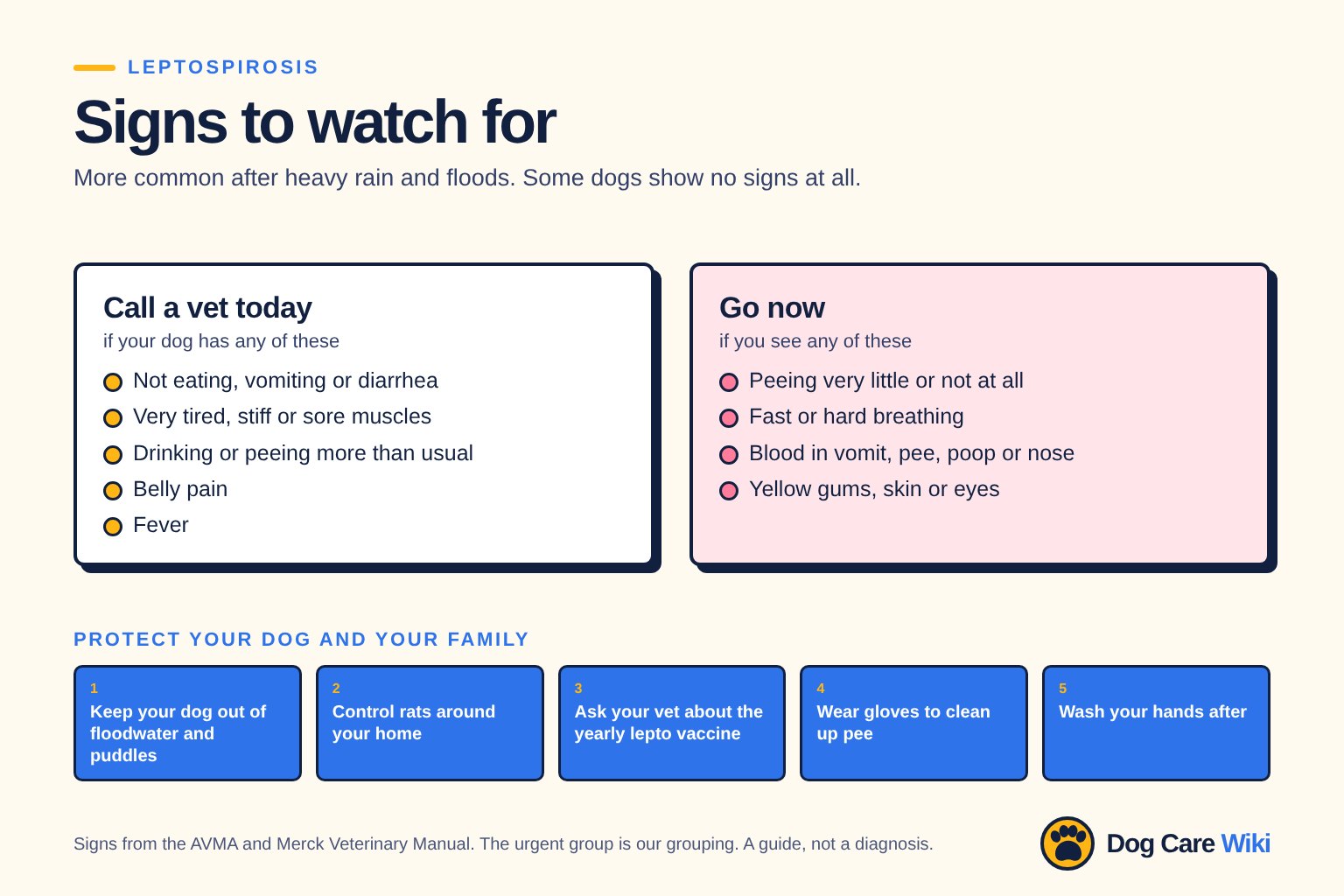
- Call a vet today: not eating, vomiting, tiredness, more thirst
- Go now: little or no pee, hard breathing, bleeding, yellow gums
- More common after heavy rain and floods
- Protect your family: gloves, handwashing, rat control
The quick guide
Loss of appetite, vomiting or diarrhea
Among the most common signs the American Veterinary Medical Association (AVMA) lists.
Tiredness, stiffness or muscle pain
Your dog may not want to move, or may seem sore when touched.
Drinking or peeing more than usual
A common sign. The Merck Veterinary Manual adds that some dogs pee very little or not at all, which is more serious.
Yellow gums, skin or eyes (jaundice)
A sign the liver may be affected. Go to a vet now.
Bleeding
The AVMA says lepto can cause bleeding problems: blood in vomit, pee, poop or saliva, nosebleeds, or tiny red spots on the gums.
Fast or hard breathing
Some dogs develop severe lung disease. This is an emergency.
No signs at all
Some infected dogs never look sick. That is one reason the vaccine and avoiding risky water matter.
What to do this week
- Check your dog's vaccine record. If there is no lepto shot, or the last one was over a year ago, ask your vet about it.
- Keep your dog out of floodwater, puddles and standing water, especially after heavy rain.
- Store food and trash where rats cannot reach them.
- Keep your dog's vaccine dates in one place with our free printable dog vaccination record.
How dogs get leptospirosis
The Merck Veterinary Manual says dogs catch it through contact with infected urine or water, through bite wounds or broken skin, by eating infected meat or dead animals, and sometimes at birth.
Rats are the main source worldwide. A 2023 statement from the American College of Veterinary Internal Medicine (ACVIM) says about 30% of brown rats worldwide carry it, and over 80% in some regions. It also says leptospirosis is especially common where it is warm and rains a lot.
Can dogs get leptospirosis from flood water? Yes, it is one of the main risks. The AVMA says outbreaks have been reported after heavy rainfall and flooding, because floodwater can carry urine from infected animals.
Can people catch leptospirosis from dogs?
It is possible, but uncommon. The AVMA calls leptospirosis one of the most widespread diseases shared between animals and people in the world, and says catching it from an infected dog or cat is much less common, but possible. The ACVIM says it does not spread easily from dog to dog or from dogs to people.
While your dog is sick and being treated:
- Wear gloves when you clean up your dog's pee, and clean it quickly with a household disinfectant (AVMA).
- Wash your hands well after handling your dog, at least until the antibiotics are finished (Merck).
- See your own doctor if you feel ill, are pregnant or have a weak immune system (AVMA).
The lepto vaccine for dogs
- Two starting doses. The ACVIM says the vaccine needs 2 first injections, 4 weeks apart, starting at 12 weeks of age or later.
- Then yearly. The ACVIM says vaccines protect for at least 12 months and should be given every year. Merck says older advice to vaccinate every 6 months is no longer justified.
- It does not cover every strain. In the US, vaccines cover four types (serovars): Canicola, Icterohaemorrhagiae, Grippotyphosa and Pomona. Merck says the vaccines do not protect against all strains. The ACVIM says some 2-strain vaccines sold in many places may not match the strains common there.
Experts differ on who needs it. The ACVIM recommends it every year for all dogs from 12 weeks, whatever their breed or lifestyle. The World Small Animal Veterinary Association (WSAVA) treats it as core where leptospirosis is common. In hot, rainy places like the Philippines, both point the same way. Ask your vet which vaccine they use and which strains it covers.
See where the lepto shot fits in the full plan in our dog vaccination schedule.
Rainy season and floods in the Philippines
Human cases rise with the rains. The Department of Health reported 2,177 human leptospirosis cases from 4 January to 6 June 2026, up 6% on the same period a year before, and warned of the usual spike from June because of monsoon floods and typhoons (as reported by the Daily Tribune).
Data on dogs is thin. The only Philippine dog study we found tested 106 dogs in 2007 and 2008 and found antibodies in 79% of them. The most common types were Manilae, Patoc and Autumnalis, which are not among the four types in US vaccines. It was a blood antibody study only, so it cannot show which type made dogs sick, and it is old. Ask your vet which lepto vaccine is available locally and what it covers.
Treatment and recovery
Leptospirosis is treated with antibiotics, and dogs with kidney or liver problems may need fluids and care in the hospital (Merck). The AVMA says the chance of recovery is good when it is treated early, but there is still a risk of lasting kidney or liver damage. Never give your dog antibiotics at home without your vet.
A vet explains leptospirosis
Dr. Hunt of Red Bank Veterinary Hospital, a US specialty hospital, explains the disease for owners. The video is from 2014, so the vaccine advice above is more current.
Our own Short, with a correction. Our 2024 YouTube Short, 5 Signs of Leptospirosis in Dogs, lists a fever as above 39°C. That is still within the normal range for a dog: the Merck Veterinary Manual gives 37.5 to 39.2°C. The Short also leaves out that some dogs pee very little or not at all, which is more serious, and that the vaccine is yearly and does not cover every strain. This guide has the updated advice.
Common questions
What are the first signs of leptospirosis in dogs?
Often loss of appetite, vomiting, tiredness, muscle pain, and drinking or peeing more than usual. Some dogs show no signs at all. If your dog may have been in floodwater and seems unwell, call your vet.
Can dogs get leptospirosis from flood water?
Yes. Floodwater can carry urine from infected animals, and the AVMA says outbreaks have been reported after heavy rain and flooding.
Can I catch leptospirosis from my dog?
It is possible but uncommon. Wear gloves to clean up your dog's pee, wash your hands after handling your dog until treatment is finished, and see your doctor if you feel ill.
How often does a dog need the lepto vaccine?
Two starting doses 4 weeks apart from 12 weeks of age, then once a year, according to the ACVIM.
Can a vaccinated dog still get leptospirosis?
Yes, but it is uncommon. The vaccines cover only some strains, so a dog can catch a type the vaccine does not include.
Can leptospirosis in dogs be cured?
Yes, with antibiotics and supportive care from a vet. Recovery chances are good when treatment starts early, though some dogs are left with kidney or liver damage.
Veterinary sources
- ACVIM consensus statement on leptospirosis in dogs and cats, 2023 update (Sykes et al., J Vet Intern Med) ↗
- Merck Veterinary Manual: Leptospirosis in dogs (owner version) ↗
- Merck Veterinary Manual: Leptospirosis in dogs (professional version) ↗
- Merck Veterinary Manual: Normal rectal temperature ranges ↗
- AVMA: Leptospirosis client brochure (2025) ↗
- AVMA News: WSAVA updates global guidelines for vaccination (2024) ↗
- Acta Medica Philippina: Leptospira antibodies in water buffaloes, pigs and dogs in the Philippines (2018) ↗
- Daily Tribune: DOH leptospirosis cases up 6% (June 2026) ↗
Medical note: This guide is educational and cannot diagnose your dog. A veterinarian who can examine your dog is the right person to give medical advice.