Parvovirus survives a long time: indoors for at least 2 months, and outdoors in shade for months or even years, according to the Merck Veterinary Manual. Most household cleaners will not kill it. What works on hard surfaces is diluted bleach (1 part to 30 parts water), accelerated hydrogen peroxide or potassium peroxymonosulfate, used on a surface that is already clean and kept wet for about 10 minutes. Fabrics go in a hot wash with bleach and a hot dryer. Yards are harder to clean, so the safest next dog is one that is already fully vaccinated. If your dog has parvo now, start with our parvo guide.
How to clean up after parvo
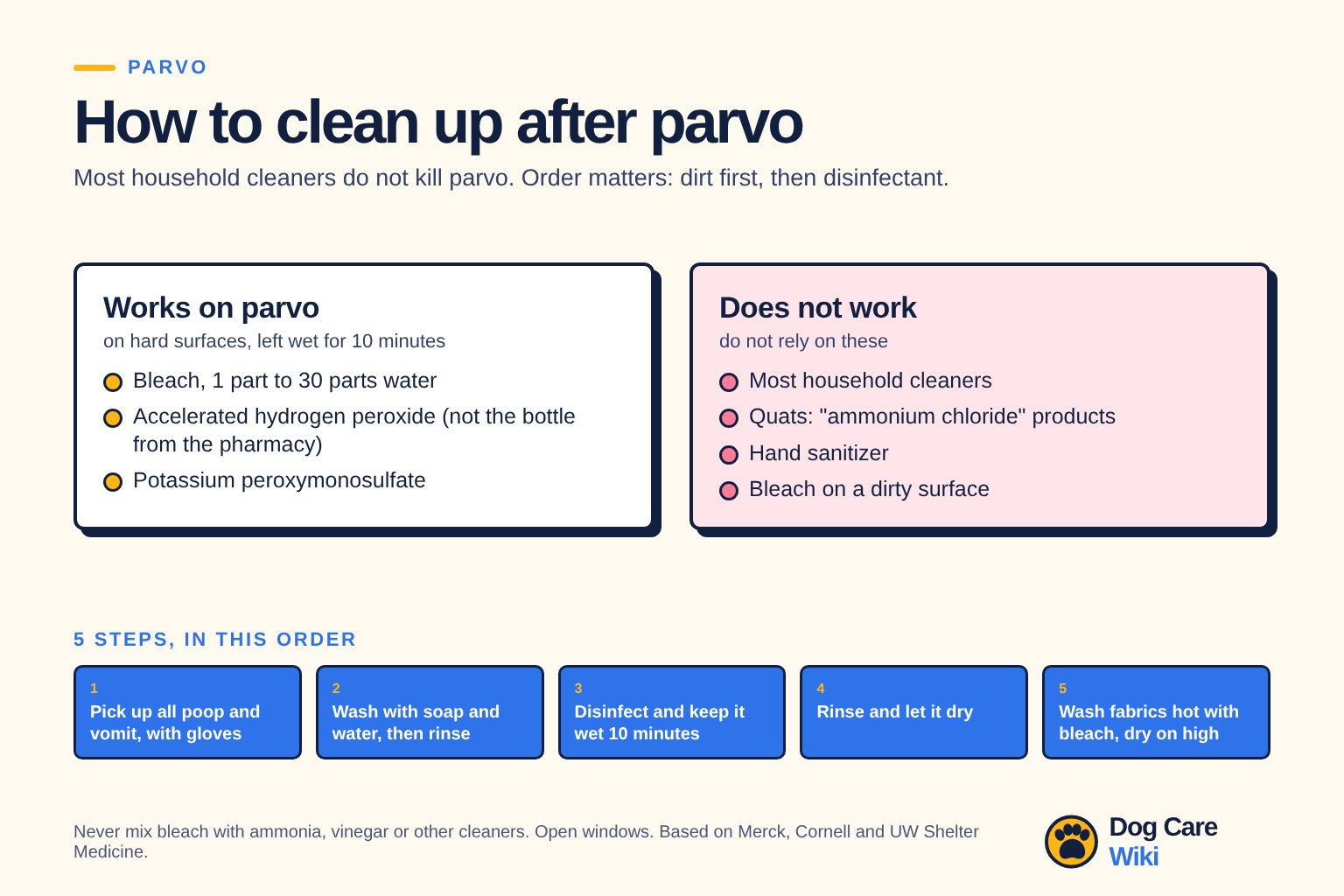
- Works: bleach 1:30, accelerated hydrogen peroxide
- Does not work: most household cleaners, quats, hand sanitizer
- Order: remove dirt, wash, rinse, then disinfect
- Keep the surface wet for about 10 minutes
The quick guide
Bleach, 1 part to 30 parts water
Cornell University says properly diluted bleach works when left for at least 10 minutes after all poop and food are removed. About ½ cup of bleach in a gallon of water, or 100 ml in 3 liters, gives roughly that mix.
Accelerated hydrogen peroxide
A professional disinfectant (one brand is Rescue). The University of Wisconsin shelter program prefers it to bleach. It is not the same as the hydrogen peroxide sold for cuts.
Potassium peroxymonosulfate
Sold under names like Virkon or Trifectant. Merck lists it as a disinfectant that kills parvo.
Most household cleaners: no
Cornell says most common household cleaners will not kill parvovirus.
Quats (ammonium chloride products): not reliable
Many disinfectant sprays and wipes use quaternary ammonium compounds. Merck says these are not reliable for parvo, and Wisconsin says independent studies show they do not reliably kill it, even when the label claims they do. Check the label: if the active ingredient ends in "ammonium chloride", do not rely on it for parvo.
Hand sanitizer: no
Wisconsin says no hand sanitizer on the market kills parvovirus. Wash your hands with soap and water, and wear gloves.
Clean in this order
- Put on gloves. Pick up all poop, vomit and food, and bag it.
- Wash the area with soap or detergent and water, then rinse well. Soap left behind can stop bleach working.
- Apply the disinfectant and keep the surface wet for about 10 minutes. Add more if it starts to dry.
- Rinse with clean water and let it dry, so no bleach is left for the next dog to touch.
- Wash bedding, towels and fabric toys hot with bleach, then dry on the highest heat or in direct sun.
Can bleach kill parvo? How to mix it
Yes, if it is mixed and used correctly. Merck, Cornell and Mar Vista Animal Medical Center all use about 1 part bleach to 30 parts water. Wisconsin uses ½ cup per gallon, which is close to 1 to 32.
- Use regular household bleach. These mixes assume bleach of about 5% strength (Merck). Check the label. Clorox says to use a newly bought bottle so it is at full strength.
- Mix it fresh. About ½ cup of bleach to a gallon of water, or 100 ml of bleach to 3 liters of water.
- Only on hard surfaces that bleach will not damage: tile, sealed floors, plastic crates, bowls.
- Keep it wet for 10 minutes, then rinse and let it dry. Clorox says to rinse thoroughly. Mar Vista says the bleach must be fully removed before a new puppy touches it.
Bedding, toys, bowls and clothes
- Anything that goes in the washing machine: wash in hot water with bleach, without overfilling, then dry on the highest heat, or outside in direct sun (Wisconsin). Mar Vista says an item that can go through the washer with bleach should be safe afterwards.
- Bowls and hard toys: soak in the bleach mix for 10 minutes, then rinse well. A dishwasher only helps if it gets above 180°F (82°C), which Wisconsin says parvo needs.
- Things you cannot bleach or wash hot: Mar Vista says the simplest answer is to throw them out, though this is probably not needed for things you can bleach.
Carpets and furniture
Soft surfaces are hard to disinfect. Wisconsin says accelerated hydrogen peroxide can be used on carpets and furniture, and to always test a small area first for color loss. Steam cleaning can help only if it reaches 75°C (167°F), which Wisconsin says home steamers may not reach. Mar Vista suggests throwing out area rugs if you can.
If an area cannot be properly disinfected, Mar Vista suggests that the next dog in the home be an older, fully vaccinated one.
How long does parvo live in the ground or yard?
Sources differ, so plan for the longer answer.
- Merck: outdoors, out of sun and not dried out, many months and possibly years.
- Wisconsin: many years in damp soil in dark places, like under porches or near leaking pipes.
- Cornell: you cannot, and should not, bleach your lawn. Rain or watering, plus sunlight, can bring the virus down to an acceptable level in a few weeks.
What helps: pick up all poop, and Mar Vista suggests shoveling out the soil around it, then hosing the area down. Wisconsin suggests flushing the yard with water, then applying accelerated hydrogen peroxide, and fencing off damp, shady spots if you can. Sunlight and drying help kill the virus.
How long does parvo live on surfaces indoors?
Merck says at least 2 months at room temperature. Cornell's canine health center says it can survive up to a year in the right conditions. The ASPCA says it can live on food bowls, shoes, clothes, carpets and floors. So clean every surface the sick dog used, and do not wait for it to wear off by itself.
When can a new puppy come home after parvo?
There is no safe waiting time that replaces cleaning. Wisconsin's shelter guide says waiting adds nothing: either the cleaning worked or it did not.
- Safest choice: Mar Vista recommends a puppy that is already immune: at least 16 weeks old, with at least 2 sets of parvo vaccine, the last one at about 16 weeks.
- A younger puppy: ask your vet about starting vaccines early. Wisconsin suggests that in a home with past parvo, puppy vaccines can start as early as 4 weeks and repeat every 2 weeks until 20 weeks of age. Your vet sets the plan.
- The dog who had parvo: Cornell says dogs can shed the virus for about 2 weeks after they recover, so keep them away from other dogs during that time. Mar Vista says a good bath should wash virus off the coat.
See where parvo shots fit in the full plan in our dog vaccination schedule.
Our cleaning Short, with corrections
Update note: our Short gets the main steps right but leaves a few things out. Wash with soap and water and rinse before using bleach. Keep the surface wet for the full 10 minutes, then rinse. Use the bleach mix on hard surfaces, and put bedding in a hot wash with bleach and a hot dryer instead. Open windows while you clean, not only after. And never mix bleach with ammonia or vinegar.
For a longer talk from a shelter vet, see Dr. Chumkee Aziz on cleaning and disinfection (Maddie's Fund, 2018). The parvo part runs from about 10 to 36 minutes.
Common questions
What kills parvo?
On hard surfaces: diluted bleach (about 1 part to 30 parts water), accelerated hydrogen peroxide, or potassium peroxymonosulfate, used on a clean surface and kept wet for about 10 minutes. Fabrics need a hot wash with bleach and a hot dryer.
Does Lysol kill parvo?
Do not rely on it. Many household disinfectant sprays and wipes use quaternary ammonium compounds, and Merck and the University of Wisconsin say these do not reliably kill parvo. Check the active ingredient; if it ends in 'ammonium chloride', use bleach or accelerated hydrogen peroxide instead.
Does vinegar or regular hydrogen peroxide kill parvo?
They are not on the lists of disinfectants that work. Accelerated hydrogen peroxide is a different, professional product. And never mix vinegar with bleach.
How long does parvo live in the ground?
Sources differ. Merck says many months and possibly years outdoors if it is shaded and damp. Cornell says watering and sunlight can lower it to an acceptable level in a few weeks. Treat shady, damp areas as risky for longer.
How long does parvo live on surfaces?
At least 2 months indoors (Merck), and up to a year in the right conditions (Cornell). Clean and disinfect everything the sick dog used.
When can I bring a new puppy home after parvo?
Cleaning matters more than waiting. The safest choice is a puppy at least 16 weeks old with at least 2 sets of parvo vaccine. For a younger puppy, ask your vet about starting vaccines early.
Veterinary sources
- Merck Veterinary Manual: Canine parvovirus infection (professional version) ↗
- Cornell Riney Canine Health Center: Parvovirus transmission and treatment ↗
- Cornell Baker Institute: Canine parvovirus ↗
- UW Shelter Medicine: Parvovirus in a home environment ↗
- UW Shelter Medicine: Canine parvovirus guidebook ↗
- UW Shelter Medicine: Hand sanitation in an animal shelter ↗
- UW Shelter Medicine: Dish sanitation in shelters ↗
- Mar Vista Animal Medical Center: Parvovirus in the environment and disinfection ↗
- ASPCA: Common dog diseases ↗
- Washington State Department of Health: Dangers of mixing bleach with cleaners ↗
- Clorox: Does bleach kill parvo on surfaces? (manufacturer) ↗
- Clorox: Dos and don'ts for cleaning with bleach (manufacturer) ↗
Medical note: This guide is educational and cannot diagnose your dog. A veterinarian who can examine your dog is the right person to give medical advice.