In the US, every dog should get the core vaccines: distemper, adenovirus (hepatitis), parvovirus and rabies. Puppies start at 6 to 8 weeks, get a shot every 2 to 4 weeks until they are over 16 weeks old, then a booster within a year. After that, AAHA recommends core boosters every 3 years. Rabies is the one vaccine set by law, and each state writes its own rules for the age of the first shot and how often boosters are due. Your vet knows your state's rules.
Puppy vaccination chart
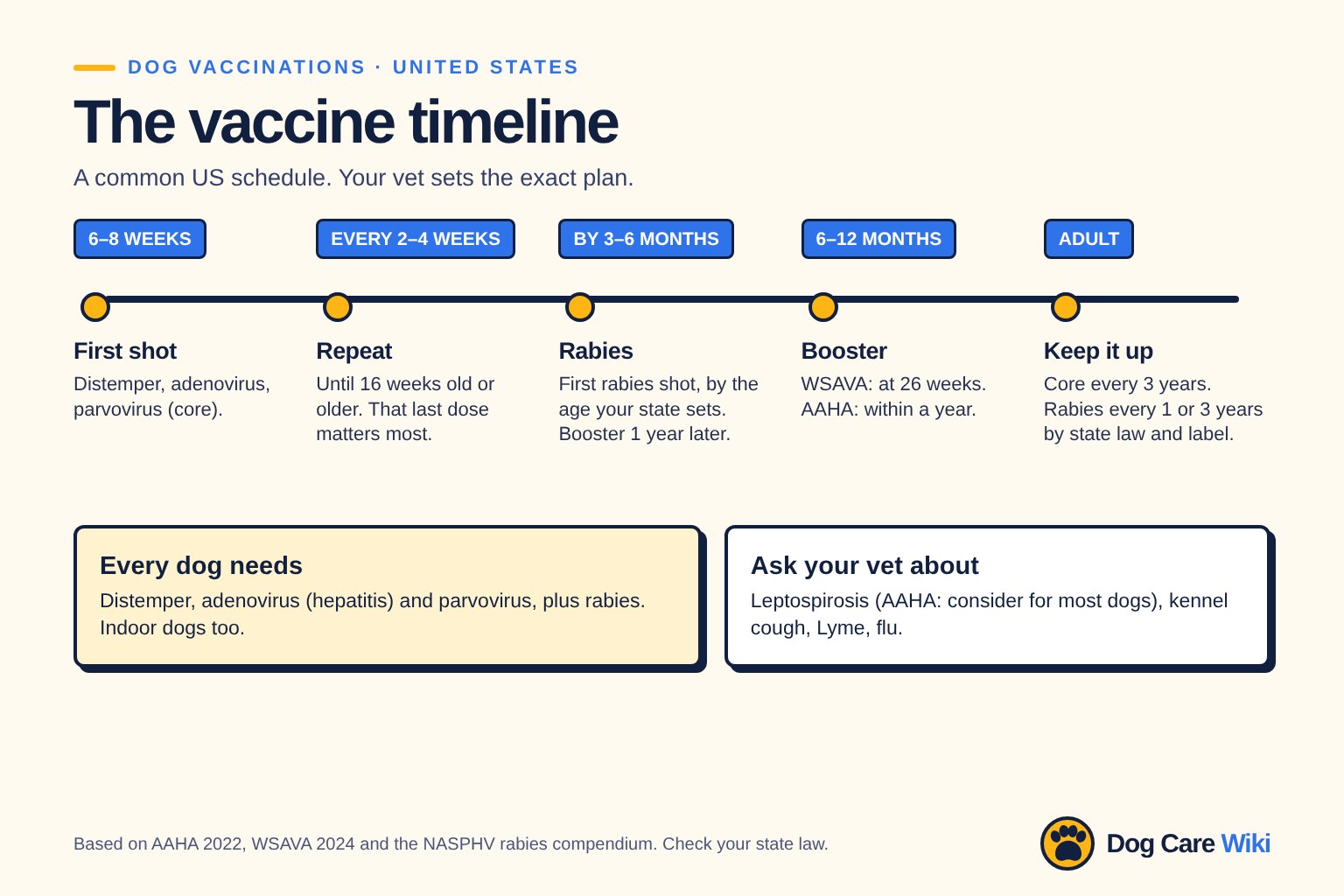
- Puppy: start at 6–8 weeks, repeat every 2–4 weeks past 16 weeks
- Rabies: first shot by the age your state sets, booster 1 year later
- Booster: within a year of the puppy series
- Adult: core every 3 years, rabies by state law and label
The quick guide
Distemper (core)
Part of the puppy series and adult boosters for every dog.
Adenovirus, or hepatitis (core)
Usually given in the same combination shot as distemper and parvovirus, often written as DHPP or DAPP.
Parvovirus (core)
Often deadly for unvaccinated puppies. See our parvo guide for the signs.
Rabies (core, and required by most states)
The only dog vaccine that most states require by law. A veterinarian writing in dvm360 notes it is required in most, but not all, states.
Parainfluenza (often included)
AAHA lists it with the core vaccines as an optional add-on. It is often part of the same combination shot.
Leptospirosis (consider for most dogs)
AAHA's 2022 guidelines say leptospirosis vaccination should be considered for most dogs because the disease is becoming more common. It needs two starting doses, then a yearly booster. See our leptospirosis guide for the signs.
Kennel cough, Lyme and dog flu (by risk)
Bordetella, Lyme disease and canine influenza vaccines depend on where your dog lives, travels, boards or plays. Some kennels and groomers require Bordetella.
What to do this week
- Find your dog's vaccine records and copy the dates onto our free printable dog shot record (PDF).
- Check when your dog's rabies certificate expires. Many cities and counties also need it for a dog license.
- Ask your vet whether your dog should have leptospirosis, kennel cough, Lyme or flu vaccines.
- Book any vaccine that is due.
- Write the next due dates in the free care planner in our dog health tracker.
US puppy vaccination schedule and puppy shots
AAHA, the American Animal Hospital Association, recommends core vaccines at 2 to 4 week intervals until the puppy is over 16 weeks old, or 18 to 20 weeks in high-risk areas. A booster follows within a year of the puppy series. WSAVA, the World Small Animal Veterinary Association, suggests that booster sooner, at or soon after 26 weeks. Ask your vet which they use.
Puppies need several shots because antibodies from their mother can block the vaccine. The last puppy dose, given after 16 weeks, matters most.
Adult dog vaccine schedule
AAHA says that after the first booster, core vaccines are given every 3 years, and that annual core boosters are not necessary. Leptospirosis and Bordetella protection is shorter, so those are usually yearly.
Rabies vaccination schedule: laws differ by state
There is no single national rabies law for dogs. Each state, and sometimes each county or city, sets its own rules:
- Age of the first shot. States set it between 3 and 6 months of age.
- Boosters. The national rabies compendium from NASPHV, the public health veterinarians' association, says a booster should be given 1 year after the first shot, whatever the dog's age. After that, boosters follow the vaccine label, every 1 or 3 years, unless your state says otherwise.
- States with no statewide rule. The Animal Legal and Historical Center at Michigan State University counts about ten states with no state-level requirement. Counties and cities in those states often have their own rules.
- Medical exemptions. The same center found that, as of 2023, only 16 states let owners seek a medical exemption from rabies vaccination.
To check your state, see the Michigan State table of state rabies vaccination laws in the sources below, then confirm with your vet or local animal control, since local rules can be stricter.
Dog shot record template (free printable)
Keep your dog's rabies certificate. Many dog licenses, boarding kennels, groomers and day cares ask for it. WSAVA recommends recording the date, vaccine name, manufacturer, lot number, who gave it, and when the next dose is due.
Print it. Free printable dog shot record (PDF). It has the common puppy schedule, the rabies notes and a record table for each shot.
Missing records? Call the clinic that gave the shots and ask for a copy, including the rabies certificate. If your dog came from a breeder, shelter or rescue, ask them too. If nothing can be found, your vet may restart the core vaccines or suggest a titer test.
Our free dog health tracker also has a simple care planner for vaccine dates, and you can join early access for reminders.
Who licenses dog vaccines, and where to get them
In the US, dog vaccines are licensed by the USDA's Center for Veterinary Biologics. Get them from a veterinary clinic or a low-cost vaccine clinic. AAHA warns that vaccines can stop working if they aren't stored and handled correctly, which is hard to guarantee outside a clinic. Rabies vaccine rules also limit who may give the shot, and a certificate from a veterinarian is usually what the law accepts.
If you're moving abroad with your dog, the country you're going to sets the entry rules. Start with the USDA APHIS pet travel pages and your vet.
Common questions
What shots does a puppy need in the US?
The core vaccines: distemper, adenovirus (hepatitis), parvovirus and rabies, often with parainfluenza in the same shot. Your vet may add leptospirosis, kennel cough, Lyme or flu based on your dog's risk.
How often does my dog need a rabies shot?
A booster 1 year after the first shot, then every 1 or 3 years, depending on your state's law and the vaccine used.
Does my dog need the DHPP shot every year?
AAHA says that after the first booster, core vaccines like DHPP are given every 3 years and annual core boosters are not necessary.
Is rabies vaccination required in every state?
No. Most states require it, but a Michigan State University review counts about ten without a statewide rule. Local governments in those states often require it.
Can my dog be exempt from the rabies vaccine?
Only in some states. As of 2023, 16 states allowed owners to seek a medical exemption. Ask your vet.
Where can I get a printable dog shot record?
Download our free printable dog shot record (PDF) from this page. It has the US puppy schedule, rabies notes and a table for the date, vaccine, brand and lot number, vet, and next due date.
Do indoor dogs need vaccines?
Yes. AAHA recommends core vaccines for all dogs, whatever their lifestyle.
Veterinary sources
- AAHA: 2022 Canine Vaccination Guidelines toolkit ↗
- AAHA 2022 guidelines summary (OAVT presentation) ↗
- WSAVA: 2024 Guidelines for the Vaccination of Dogs and Cats ↗
- NASPHV: Compendium of Animal Rabies Prevention and Control, 2016 ↗
- Animal Legal and Historical Center (Michigan State University): Table of state rabies vaccination laws ↗
- Animal Legal and Historical Center: Rabies vaccination and exemption laws for dogs (2023) ↗
- dvm360: A better understanding of rabies laws and regulations (2023) ↗
- USDA APHIS: Veterinary biologics ↗
- USDA APHIS: Pet travel ↗
- VCA: Allergic reactions in pets ↗
Medical note: This guide is educational and cannot diagnose your dog. A veterinarian who can examine your dog is the right person to give medical advice.