VCA Animal Hospitals describes vomiting as bringing up "fluid, froth, or food." VCA also notes vomit can turn foamy once the stomach has been emptied. So white foam often just means there was no food left to bring up. Many causes are mild, like an upset stomach or eating grass. A few are emergencies. The most important one is bloat, where a dog keeps trying to vomit but little or nothing comes up. Watch how your dog acts, not only what comes out.
When white foam is an emergency
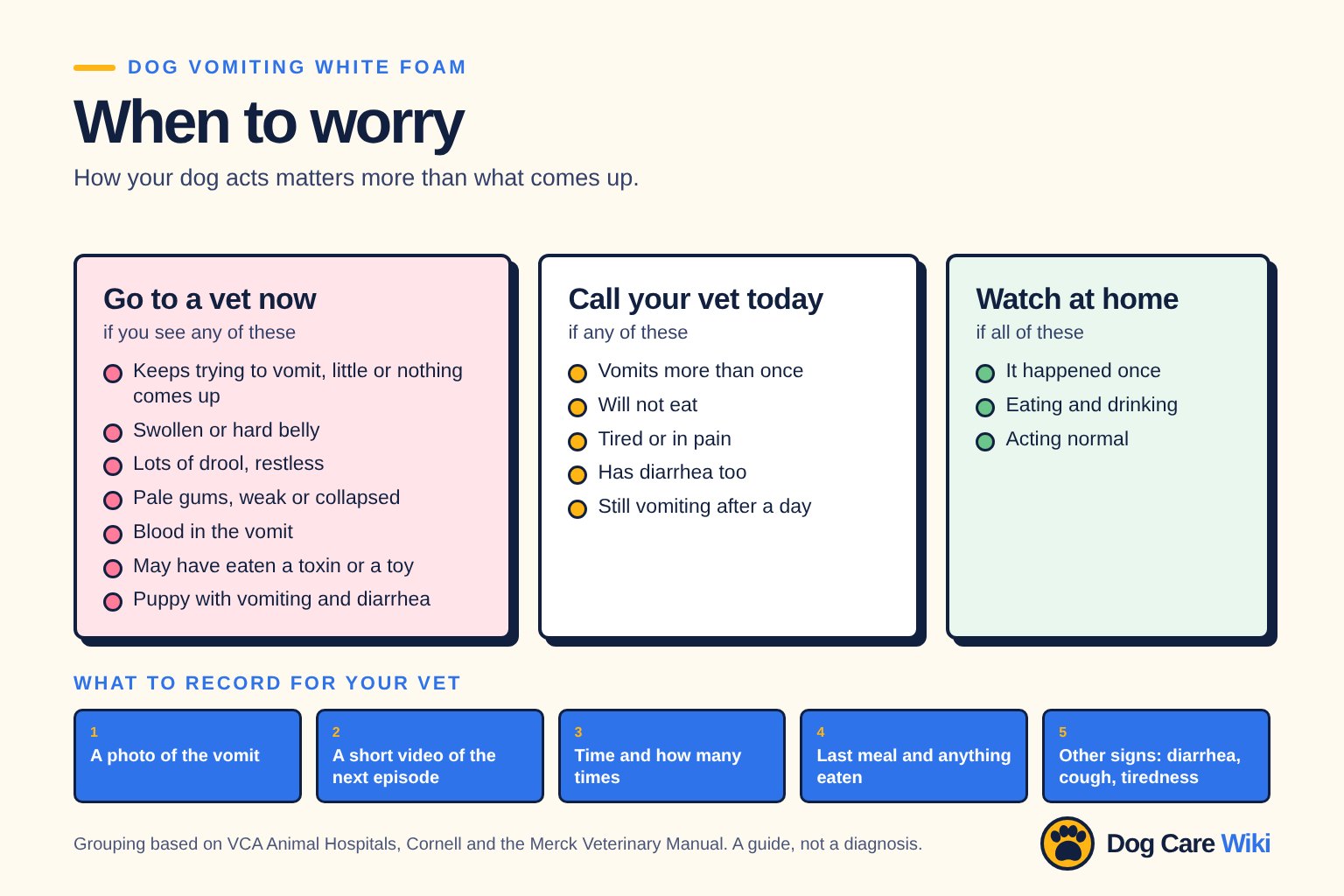
- Go now: retching with nothing coming up, swollen belly
- Go now: blood, toxins, weak puppy
- Call today: more than once, not eating, tired
- Watch at home: once, and acting normal
The quick guide
The color of the foam alone cannot tell you the cause. How often it happens and how your dog is acting matter more.
An empty or upset stomach
When the stomach is empty, vomit is often just fluid and froth. Before vomiting, VCA says a dog may "lick its lips, salivate, and repeatedly swallow." One episode in a dog who then eats and plays is often minor.
Bile in the morning
Some dogs vomit early in the morning when the stomach has been empty all night. The University of Illinois vet college calls this bilious vomiting syndrome. The vomit is often yellow or green, and it can look foamy. A vet should confirm it first, because other illnesses can look the same.
Eating grass or something they found
VCA says less than 25% of dogs vomit after eating grass. Rubbish, table scraps and spoiled food are common causes of an upset stomach too.
Coughing, not vomiting
A dog with kennel cough can cough hard, then gag up foam. The Merck Veterinary Manual describes a "goose honk" cough that may be followed by retching and gagging. A short video helps your vet tell a cough from a vomit.
Bloat (GDV)
Trying to vomit again and again with only foam or nothing coming up, plus drooling and restlessness, can be bloat. This is an emergency. See our bloat guide for the signs.
Something more serious
VCA lists swallowed toys or objects, toxins, pancreatitis, and liver or kidney disease among the serious causes of vomiting. In puppies, vomiting with diarrhea can be parvo.
What to do right now
- Check your dog. Is your dog bright, or tired and in pain? Is the belly swollen? Is your dog trying to vomit with nothing coming up?
- Take a photo of the vomit and, if it is safe, a short video of the next episode.
- Write down the time, how many times, the last meal, and anything your dog may have eaten.
- Keep fresh water out. Ask your vet before you hold back food.
- Do not give human medicine, and do not try to make your dog vomit, unless a vet tells you to.
Dog vomiting white foam but acting normal
This is the most common question. VCA says: "If your pet is eating, drinking and behaving normally after a single episode of vomiting, you can monitor your pet at home." VCA also says many cases of sudden vomiting get better on their own within 24 hours.
Call your vet if:
- It happens again, or more than once in a day.
- Your dog will not eat or seems tired.
- Your dog also has diarrhea.
- It keeps happening. VCA says to see a vet if a dog that seems well keeps vomiting for more than one to two days.
- It comes back often. Cornell University says vomiting even once a week may be a sign of disease.
The vet in the video below says puppies and small breeds are at higher risk of dehydration, so call sooner for them.
Is it vomiting, regurgitation or coughing?
These look alike, but they mean different things. Your vet will want to know which one it was.
- Vomiting. The belly pushes hard. VCA says it "typically involves abdominal contractions and effort."
- Regurgitation. Food or fluid comes up with no warning and no pushing. VCA says it "often occurs immediately after eating or drinking." It can point to a problem in the tube from the mouth to the stomach.
- Coughing. A honking or hacking cough, then a gag that brings up a little foam.
A 10 second video on your phone is often the best thing you can bring to the vet.
What you can safely do at home
Many searches ask for home treatment for white foam vomiting. There is no home cure, because foam is a sign, not an illness. Here is what is safe for a dog who vomited once and is otherwise acting normal:
- Keep fresh water out, in small amounts if your dog drinks fast and vomits again.
- Call your vet before you skip meals. Vet advice on holding back food differs, so ask what is right for your dog.
- If your vet finds it is bile on an empty stomach, they may suggest a small meal late in the evening. The University of Illinois says many dogs do well with a small meal right before bed.
- Do not give human medicine unless your vet tells you to.
If you think your dog ate something toxic, call your vet or nearest 24-hour animal hospital now. In the US you can also call the ASPCA Animal Poison Control Center at (888) 426-4435.
When white foam means bloat
Bloat (gastric dilatation-volvulus, or GDV) is when the stomach fills with gas and can twist. The Merck Veterinary Manual lists "nonproductive retching, hypersalivation, and restlessness" as signs. Hypersalivation means a lot of drooling. Nonproductive retching means trying to vomit with little or nothing coming up.
It is most common in large, deep-chested dogs, but VCA says any dog can bloat. It is deadly without treatment. Go to the nearest vet right away. Read the full bloat in dogs guide.
Videos: a vet explains, and our TikTok
A vet at Beach Avenue Animal Hospital in Vancouver, Canada explains when vomiting is worth watching and when to worry. The video suggests holding back food for 8 to 12 hours after one vomit. Ask your own vet first, as advice on this differs.
Our own post, with a correction. Slide 2 of our TikTok post says white foam vomit comes from a buildup of stomach acids, indigestion or acid reflux. That can be true, but it leaves out bloat, coughing and the serious causes above. This guide has the fuller advice.
See all six vomit colors in our dog vomit color guide.
Common questions
Why is my dog vomiting white foam?
Often because the stomach is empty and upset, for example after eating grass or something from the rubbish. Coughing can also bring up foam. Less often it is a sign of bloat, a blockage, a toxin, pancreatitis, or liver or kidney disease.
My dog is vomiting white foam but acting normal. What should I do?
If it happened once and your dog is eating, drinking and acting normally, VCA says you can watch at home. Call your vet if it happens again, your dog stops eating, seems tired, has diarrhea, or keeps vomiting for more than a day or two.
When is white foam vomit an emergency?
Go to a vet now if your dog keeps trying to vomit but little or nothing comes up, has a swollen belly, is drooling and restless, has pale gums, collapses, has blood in the vomit, or may have eaten a toxin or a toy.
My dog vomited white foam several times. Is that serious?
Vomiting more than once in a short time needs a call to your vet. Repeated vomiting can cause dehydration fast, especially in puppies and small dogs.
Can a dog die after vomiting white foam?
Foam itself is not dangerous, but some causes can be. Bloat, which shows as retching with little or nothing coming up, is deadly without treatment. Parvo, toxins and blockages can also be fatal. Go to a vet quickly if your dog seems unwell.
What is the treatment for a dog vomiting white foam at home?
There is no home cure because foam is a sign, not an illness. Keep water out, ask your vet before holding back food, and do not give human medicine. If your vet finds it is bile on an empty stomach, a small late evening meal may help.
Is white foam vomit the same as yellow vomit?
Not always. Yellow or green usually means bile. A dog with an empty stomach can bring up either, and the University of Illinois says bile can look foamy too.
Veterinary sources
- VCA Animal Hospitals: Vomiting in dogs ↗
- VCA Animal Hospitals: Top reasons pets vomit ↗
- VCA Animal Hospitals: Gastroenteritis in dogs ↗
- VCA Animal Hospitals: Why dogs eat grass ↗
- Cornell University College of Veterinary Medicine: Vomiting ↗
- University of Illinois College of Veterinary Medicine: Bilious vomiting syndrome ↗
- Merck Veterinary Manual: Vomiting in dogs (owner version) ↗
- Merck Veterinary Manual: Kennel cough ↗
- Merck Veterinary Manual: Gastric dilation and volvulus in small animals ↗
- ASPCA Animal Poison Control ↗
Medical note: This guide is educational and cannot diagnose your dog. A veterinarian who can examine your dog is the right person to give medical advice.