Bloat is when a dog's stomach fills with gas. In the worst form, the stomach also twists. Vets call this gastric dilatation-volvulus, or GDV. Cornell says the twist restricts blood flow to the stomach. Bloat can kill a dog within hours. Cornell University says that without medical and surgical treatment, "GDV is fatal." With fast treatment, most dogs survive. It is most common in large, deep-chested dogs, but any dog can bloat.
Bloat signs and what to do
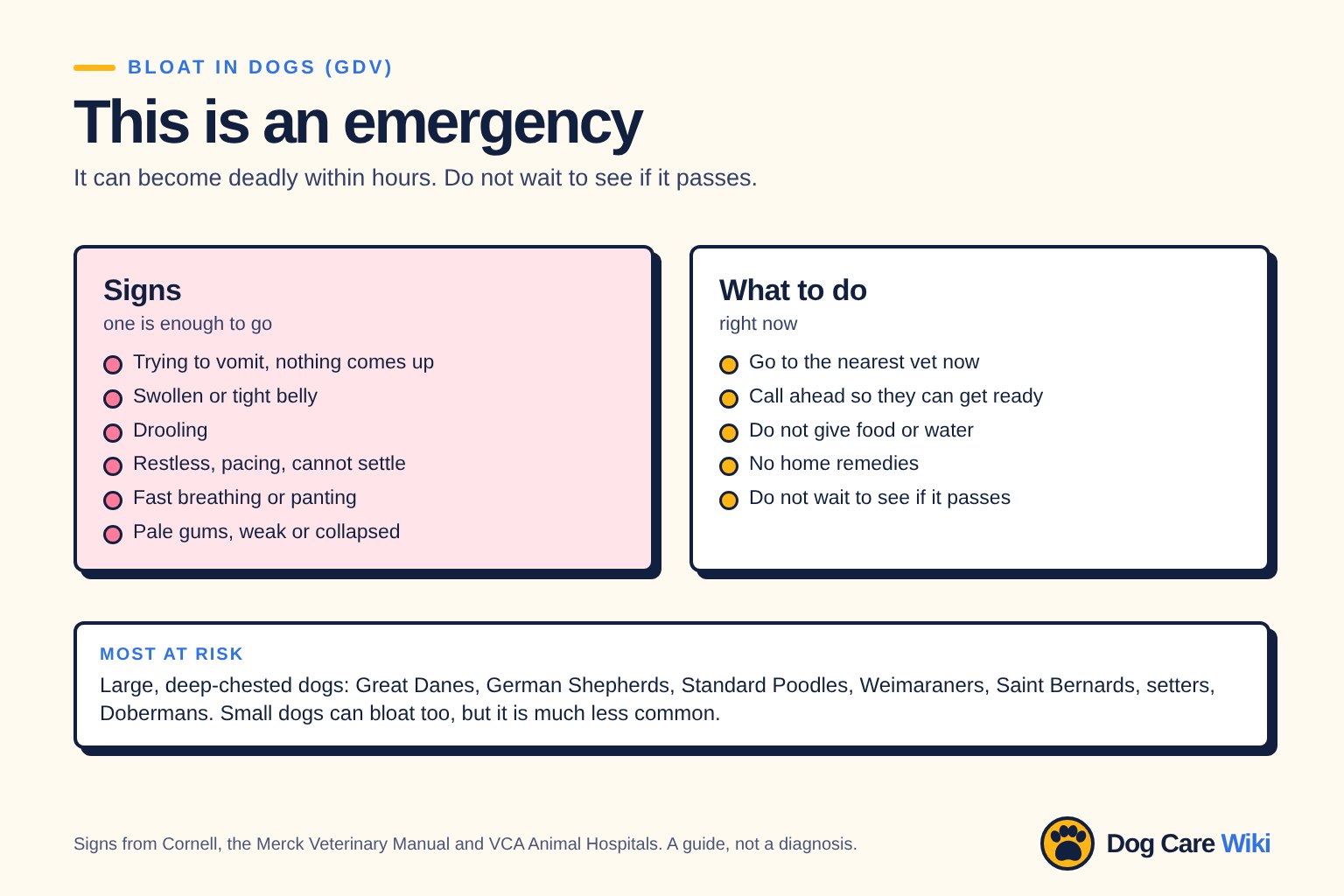
- Trying to vomit, nothing comes up
- Swollen or tight belly, drooling, pacing
- Go now, and call ahead
- No food or water, no waiting
The quick guide
Trying to vomit but nothing comes up
The classic sign. The Merck Veterinary Manual calls it "nonproductive retching." A dog may bring up a little foam or nothing at all. The VCA Northwest Veterinary Specialists handbook says unproductive retching in a medium to large dog "is a true emergency."
A swollen, tight or painful belly
VCA says the swelling is often "most obvious on the left side." It can be hard to see in a deep-chested or fluffy dog, so do not wait for it.
Drooling
Much more drool than usual. Merck lists heavy drooling as a sign.
Restless, pacing, cannot settle
Cornell lists restlessness and pacing. The American College of Veterinary Surgeons (ACVS) adds an anxious look, looking at the belly, and standing and stretching.
Fast breathing or panting
VCA says the enlarged stomach presses on the diaphragm, the muscle under the lungs, so breathing gets harder.
Pale gums, weakness or collapse
Signs of shock. Cornell lists pale gums and weakness or collapse. The dog needs a vet that minute.
The praying position
Cornell lists a "praying" position, with the front legs stretched forward and the chest close to the ground.
If you have a large or deep-chested dog, do this now
- Save the number and address of your nearest 24-hour animal hospital in your phone.
- Feed two or more smaller meals a day instead of one big meal.
- Slow down a fast eater, for example with a slow-feeder bowl.
- Keep your dog calm and limit hard exercise around meals.
- Ask your vet about a preventive gastropexy, especially if your dog is a high-risk breed or a close relative has had bloat.
Bloating versus bloat: can you tell at home?
No, not safely. There are two kinds of bloat:
- Simple bloat (gastric dilatation). The stomach fills with gas, food or fluid but does not twist. VCA says "sometimes, the condition progresses no further than a bloat."
- GDV. The swollen stomach twists on itself. This is the deadly form.
VCA says the two "often look identical on physical examination." Even a vet needs an X-ray to tell them apart. Merck says "radiographs help distinguish simple gastric dilation from GDV." Radiographs means X-rays.
A dog who passed gas and is happy, eating and playing is probably just gassy. A dog who is trying to vomit, drooling, restless or has a tight belly needs a vet now, even if it turns out to be simple bloat.
Dog bloat timeline: how fast does it happen?
Fast. A dog can go from restless to collapsed within hours.
- VCA says treatment is needed "within minutes to a few hours."
- The ACVS says dogs that have had signs for more than 6 hours have a higher risk of dying.
- Cornell says that without treatment, GDV is fatal.
There is no safe time to wait. If you are not sure, go.
Treatment and survival
At the clinic, the vet treats shock with fluids, releases the gas from the stomach, and takes X-rays (ACVS, Merck and Cornell). Cornell says prompt surgery is then needed to turn the stomach back and restore its blood supply. VCA says the most common surgery also stitches the stomach to the belly wall. This is called a gastropexy.
Survival is good when treatment is fast, but the numbers vary by study:
- Cornell says survival with medical and surgical treatment is "greater than 80 percent."
- The ACVS puts the death rate at "approximately 15%."
- VCA gives a wider death rate of "10%-45%," depending on how sick the dog is.
Bloat can come back. Cornell says a gastropexy lowers the chance of it coming back to "as low as 3-5 percent, compared to a recurrence rate as high as 80 percent without it."
Which dogs are most at risk?
Large and giant dogs with deep chests. The Merck Veterinary Manual names "Great Danes, German Shepherd Dogs, Irish Setters, Gordon Setters, Weimaraners, Saint Bernards, Standard Poodles, and Bassett Hounds." VCA adds the Doberman Pinscher and Old English Sheepdog. VCA says dogs over 100 pounds (about 45 kg) have about a 20% lifetime risk.
Other risk factors vets list (VCA and Merck):
- Being middle-aged or older.
- A parent, brother or sister who had bloat.
- Eating fast.
- Eating one meal a day.
- Being thin or underweight.
- A nervous or anxious temperament, or stress.
- Raised food bowls. Merck and Cornell both advise against them.
Studies do not all agree on every one of these. VCA says results on other risk factors "have been inconsistent."
Can small dogs get bloat?
Yes, but it is much less common. Cornell says GDV "can occur in any sized dog or breed," but is "far more common in large, deep-chested dogs." VCA says "any dog can bloat, even dachshunds and chihuahuas," and that simple bloat, usually without the twist, "occasionally occurs in elderly, small dogs."
If you have a small breed, like a Shih Tzu, the risk is lower, but the warning signs are the same. A small dog trying to vomit with nothing coming up still needs a vet.
How to help prevent bloat
You cannot prevent every case, but you can lower the risk. The Merck Veterinary Manual suggests:
- Several small meals a day instead of one large meal.
- Limiting exercise before and after meals.
- Keeping mealtimes calm.
- Avoiding raised food bowls.
- Not breeding dogs whose close relatives have had bloat.
Preventive gastropexy. This surgery attaches the stomach to the body wall so it cannot twist. The ACVS says it is "currently being recommended by many veterinary surgeons for breeds at risk" and can often be done during a spay or neuter. Cornell notes it lowers the risk of twisting "but does not prevent bloating." Ask your vet whether it makes sense for your dog.
A vet explains bloat
A vet from Vets Now, a group of emergency vet clinics in the UK, explains the signs, the breeds most at risk, and how to lower the risk.
If your dog is bringing up white foam, see our guide to dog vomiting white foam, and our dog vomit color guide.
Common questions
What are the first signs of bloat in dogs?
Trying to vomit with little or nothing coming up, drooling, restlessness or pacing, and a swollen or tight belly. Later signs include fast breathing, pale gums, weakness and collapse. Go to a vet right away.
How fast does bloat kill a dog?
It can become deadly within hours. VCA says treatment is needed within minutes to a few hours, and the ACVS says dogs with signs for more than 6 hours have a higher risk of dying.
Can bloat in dogs go away on its own?
Simple gas bloat sometimes settles, but you cannot tell it apart from a twisted stomach at home. VCA says the two often look identical, and Cornell says GDV is fatal without treatment. Do not wait.
Is there a home remedy for dog bloat?
No. Do not give food, water or home remedies. Go to the nearest vet. The VCA Northwest Veterinary Specialists handbook warns that food or water may make it worse.
Can small dogs get bloat?
Yes, but it is much less common. VCA says any dog can bloat, even dachshunds and chihuahuas. The signs are the same, so a small dog trying to vomit with nothing coming up still needs a vet.
How can I prevent bloat in my dog?
Feed several smaller meals instead of one big one, slow down fast eaters, keep meals calm, limit exercise around meals and avoid raised bowls. For high-risk breeds, ask your vet about a preventive gastropexy.
What is the survival rate for bloat in dogs?
It depends on how fast the dog is treated. Cornell says survival with medical and surgical treatment is greater than 80 percent. VCA gives a death rate between 10% and 45%.
Veterinary sources
- Cornell University College of Veterinary Medicine: Gastric dilatation-volvulus (GDV) or bloat ↗
- VCA Animal Hospitals: Gastric dilatation and volvulus in dogs ↗
- American College of Veterinary Surgeons: Gastric dilatation-volvulus ↗
- Merck Veterinary Manual: Gastric dilation and volvulus in small animals ↗
- Merck Veterinary Manual: Disorders of the stomach and intestines in dogs (owner version) ↗
- VCA Northwest Veterinary Specialists: Pet emergency care handbook (PDF) ↗
Medical note: This guide is educational and cannot diagnose your dog. A veterinarian who can examine your dog is the right person to give medical advice.