Most puppies bite because biting is how they play. To reduce it, stop the game the moment teeth touch skin, offer a toy instead, and give an overtired puppy a nap. Keep your hands still, skip hitting and shouting, and make sure everyone at home responds the same way.
Four calm steps when your puppy bites
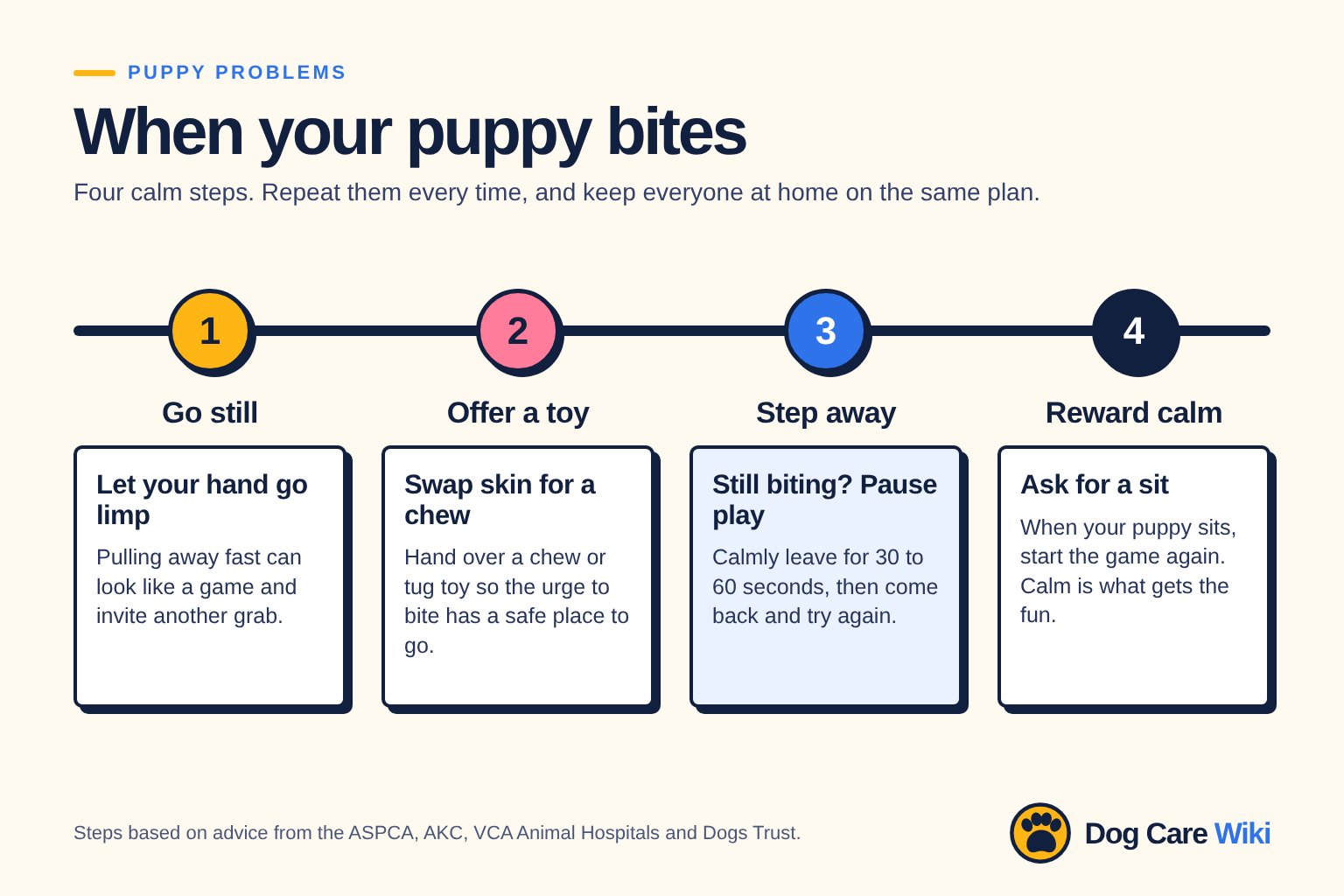
- Go still and let your hand go limp
- Offer a chew or tug toy instead
- Still biting? Step away for 30 to 60 seconds
- Ask for a sit, then restart the game
The quick guide
End the game when teeth touch skin
Go still and let your hand go limp. Pulling away fast can look like a game and invite another grab. If your puppy keeps going, calmly step away for 30 to 60 seconds, then come back and start again.
Give your puppy something better to bite
Keep a chew or tug toy within reach in every room you play in. When your puppy goes for hands, feet, or sleeves, offer the toy instead. This gives the urge to chew a safe place to go.
Check whether your puppy is overtired
Overtired puppies are often mouthier puppies. If the biting gets wild in the evening or after a busy day, try a quiet nap in a crate or pen.
Reward calm behavior
Ask for a sit before play starts. When your puppy sits, start the game or hand over the toy. Your puppy learns that calm behavior is what gets the fun going.
Get everyone on the same plan
Every person in the house needs to respond the same way. If one person allows hand-biting games, the puppy learns that hands are toys. Children should not chase or tease the puppy, because that winds them up.
What to skip
- Do not hit, tap the nose, or shake the scruff. Physical punishment can make puppies bite harder.
- Do not shout. Raised voices can add to frustration and fear.
- Do not pull your hand away fast. Quick movement can turn biting into a chase game.
- Do not play with your hands or feet. Use a toy so your skin is never part of the game.
Common questions
Is puppy biting normal?
Yes. Mouthing and play biting are a normal part of how puppies play. The goal is to teach a softer mouth and give your puppy better things to chew.
Should I yelp when my puppy bites?
Some trainers suggest a short, high "ouch" to mark a bite. It helps some puppies and winds others up. If your puppy bites harder after a yelp, skip it. Go still and end the game instead.
Should I punish my puppy for biting?
No. Hitting, scruff shaking, and shouting can make biting worse and can make your puppy wary of hands. Veterinary behavior experts recommend reward-based training instead.
How long does it take to stop puppy biting?
It varies by puppy. Many puppies become much less mouthy between 4 and 6 months of age as teething ends, especially with steady practice. See our guide: When Will Puppy Biting Stop?
Veterinary sources
- ASPCA: Mouthing, Nipping and Biting in Puppies ↗
- VCA Animal Hospitals: Play Biting in Puppies ↗
- American Kennel Club: How to Stop Puppy Mouthing and Teach Better Bite Habits ↗
- American Kennel Club: How to Stop Puppy Biting and Train Bite Inhibition ↗
- Dogs Trust: Mouthing, nipping and puppy biting ↗
- American Veterinary Society of Animal Behavior: Position Statement on Humane Dog Training ↗
Medical note: This guide is educational and cannot diagnose your dog. A veterinarian who can examine your dog is the right person to give medical advice.